Walk through the fertilizer aisle at any garden center and you’ll notice three numbers printed prominently on every bag or bottle, such as 10-10-10, 5-10-5, or 16-4-8. These are called the N-P-K numbers, and they tell you the percentage of the three primary nutrients plants need to grow.
Understanding these numbers can help you choose the right fertilizer—and avoid applying nutrients your garden may not need.
The N-P-K numbers on a fertilizer label represent the percentage of nitrogen, phosphorus, and potassium contained in the product.
What Does N-P-K Mean?
The three letters stand for the primary plant nutrients:

- N = Nitrogen
- P = Phosphorus
- K = Potassium
Each nutrient plays a different role in plant growth.
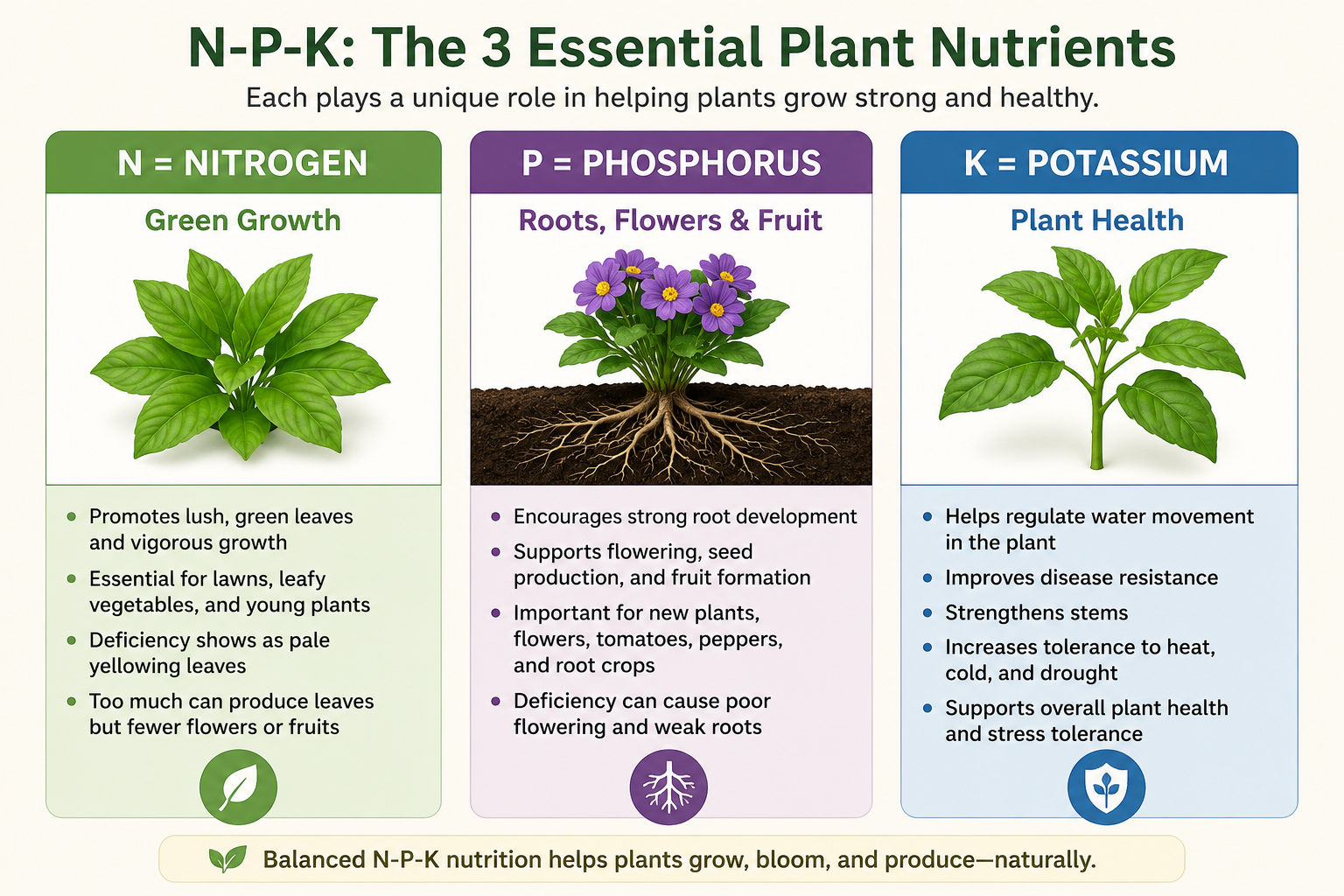
Nitrogen (N): Green Growth
Nitrogen is responsible for lush, green leaves and vigorous plant growth. It is especially important for lawns, leafy vegetables such as lettuce and spinach, and young plants establishing themselves.
A nitrogen deficiency often appears as pale green or yellow leaves, especially on older foliage.
Too much nitrogen, however, can produce beautiful leaves but very few flowers or fruits.
Phosphorus (P): Roots, Flowers, and Fruit
Phosphorus encourages strong root development, flowering, seed production, and fruit formation. It is particularly important for newly planted trees, flowering plants, tomatoes, peppers, and many root crops.
In many California gardens, phosphorus levels are already adequate because it remains in the soil for many years. Adding more phosphorus without a soil test often provides little benefit.
Potassium (K): Plant Health
Potassium helps regulate water movement within the plant, improves disease resistance, strengthens stems, and increases tolerance to heat, cold, and drought.
Plants with adequate potassium are generally healthier and better able to withstand environmental stress.
The Numbers
Who Decides the N-P-K Numbers?
The N-P-K numbers printed on fertilizer packages are regulated by state fertilizer laws, which require manufacturers to guarantee the nutrient content listed on the label. In California, fertilizer products are regulated by the California Department of Food and Agriculture (CDFA).
Manufacturers must test their products and certify that the percentages of nitrogen (N), available phosphate (P₂O₅), and soluble potash (K₂O) meet the guaranteed analysis shown on the label. State agencies periodically sample fertilizers and conduct laboratory testing to verify that the products contain what the manufacturer claims.
This means the numbers on the package are not marketing claims—they are a guaranteed minimum analysis that manufacturers are legally responsible for meeting.
How to Read the Numbers
Let’s look at a fertilizer labeled 10-10-10.
This means the fertilizer contains:
- 10% Nitrogen
- 10% Phosphorus (reported as phosphate)
- 10% Potassium (reported as potash)
The remaining 70% consists of other materials such as carriers, organic matter, or ingredients that help distribute the nutrients evenly.
A fertilizer labeled 16-4-8 contains much more nitrogen than phosphorus or potassium, making it useful when promoting leafy growth.
More Isn’t Better
One of the biggest misconceptions is that applying more fertilizer automatically produces healthier plants.
Plants can only use so many nutrients. Excess fertilizer can:
- Burn plant roots
- Promote weak, overly lush growth
- Wash into storm drains and waterways
- Waste money
Always follow the fertilizer label for application rates, but remember that the label tells you how to apply the product—not whether your soil actually needs it. A soil test and the needs of the specific plant should guide your decision.
Start With Healthy Soil
Healthy soil does much of the work for you.
Adding compost each year improves soil structure, increases water-holding capacity, and feeds the beneficial microorganisms that gradually release nutrients to plants.
Many established gardens require less fertilizer than gardeners think, especially when organic matter is regularly added to the soil.
Should You Test Your Soil?
A soil test is one of the best investments a gardener can make.
Rather than guessing which fertilizer to buy, a soil test tells you:
- Soil pH
- Existing nutrient levels
- Organic matter content
- Recommendations for any needed amendments
This allows you to fertilize based on facts instead of assumptions.
Can AI Help Diagnose Plant Problems?
Today’s gardeners have another useful tool: plant identification and diagnostic apps that use artificial intelligence (AI). By taking a photo of a plant, these apps can often identify the species, recognize signs of stress, and suggest possible causes such as nutrient deficiencies, pests, diseases, or improper watering.
Many apps can also provide general fertilizer recommendations for specific plants.
However, these apps should be viewed as a starting point—not a final diagnosis.
A photograph cannot measure your soil’s nutrient levels, pH, or organic matter. Yellow leaves, for example, may be caused by a nitrogen deficiency, overwatering, poor drainage, root damage, insects, disease, or simply the natural aging of the plant.
The best results come from combining several sources of information:
- Observe the plant carefully.
- Use a reputable plant identification app.
- Read the fertilizer recommendations for that specific plant.
- When problems persist, perform a soil test or consult your local University Cooperative Extension office.
AI is becoming a valuable gardening assistant, but healthy plants still depend on understanding the soil they grow in.
How Much Fertilizer Does a Plant Need?

One of the most common questions gardeners ask is, “How much fertilizer should I apply?”
The answer is simple:
It depends on the plant.
Tomatoes, citrus trees, roses, lawns, blueberries, and succulents all have different nutrient requirements and are fertilized at different times of the year.
The best source of application rates is usually the plant’s care information from:
- The plant tag or nursery label
- University Cooperative Extension publications
- The fertilizer manufacturer’s label
- Reliable gardening references for your specific plant
Rather than applying fertilizer on a fixed schedule, experienced gardeners observe their plants, build healthy soil with compost, and fertilize only when the plant needs additional nutrients.
A soil test, combined with plant-specific recommendations, is the best way to determine both how much and when to fertilize.
Frequently Asked Questions
What do the N-P-K numbers mean?
They show the percentage of nitrogen (N), phosphorus (P), and potassium (K) in a fertilizer.
Can too much fertilizer hurt plants?
Yes. Excess fertilizer can burn roots, reduce flowering, waste money, and pollute waterways.
Should every plant receive the same fertilizer?
No. Different plants have different nutrient needs. Follow recommendations for the specific plant and consider a soil test before fertilizing.
The Bottom Line
The N-P-K numbers are simply a guide to what’s inside a fertilizer package. They don’t tell you whether your soil actually needs those nutrients.
For most home gardeners, success starts with building healthy soil through compost, watering properly, and fertilizing only when needed.
Remember:
Feed the soil first, and the soil will help feed your plants.
That simple approach often produces healthier gardens while reducing unnecessary fertilizer use.